

HAIR RESTORATION · LONDON
DHI Hair Transplant
Direct Hair Implantation places each graft in one controlled motion, giving fine command of angle and depth where it matters most: your hairline.
Last clinically reviewed: August 2026
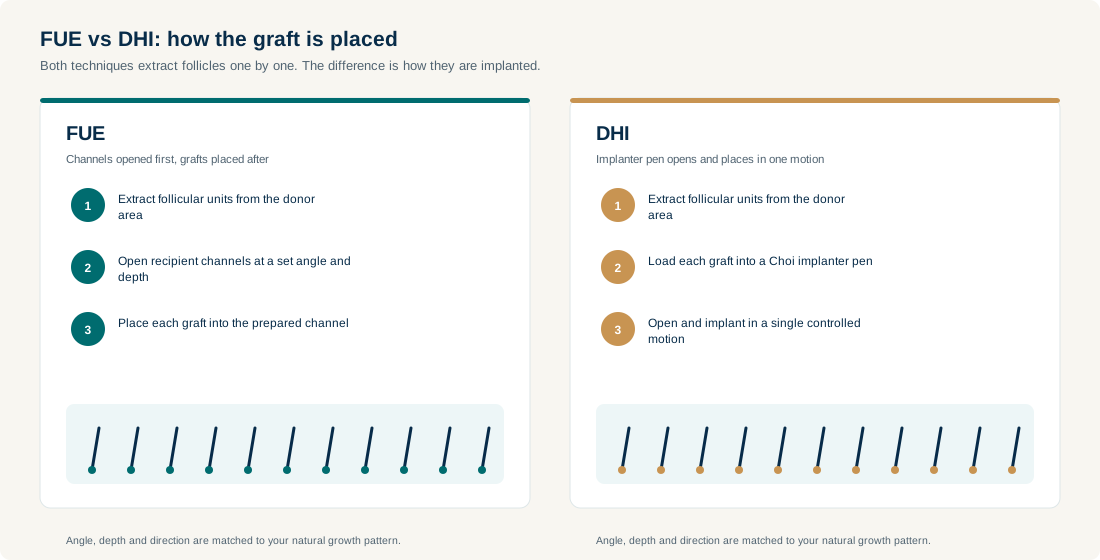
DHI uses a Choi implanter pen to open the recipient site and place the graft in a single motion, giving very fine control over angle, depth and direction.
Direct Hair Implantation is not a different way of harvesting hair. Extraction is the same follicular unit process used in FUE. What changes is implantation: instead of creating channels first and placing grafts into them afterwards, each graft is preloaded into a hollow needle and delivered directly.
Where DHI has the edge
- Very precise control of exit angle, which matters most along the hairline
- Shorter time between extraction and placement for each individual graft
- Less manipulation of the graft with forceps
- Dense packing between existing hairs without disturbing them
- Often possible with limited or no shaving of the recipient area
Because grafts are placed between existing hairs with minimal disruption, DHI is particularly useful for men who are thinning rather than bald, and for anyone who cannot take visible downtime.
The trade-offs
DHI is slower per graft than FUE, which means larger sessions take longer or need a larger team. Clinics often charge more for it, and it is not always the better clinical choice.
| Consideration | FUE | DHI |
|---|---|---|
| Speed for large sessions | Faster | Slower per graft |
| Angle precision | Very good | Excellent |
| No-shave feasibility | Limited | Often possible |
| Typical use | Full coverage | Hairline and infill |
| Relative cost | Standard | Usually higher |
For a 4,000 graft case rebuilding an entire frontal third and crown, FUE is frequently the more practical option. For a 1,800 graft hairline refinement in a man who still has plenty of native hair, DHI often wins. Our full comparison guide goes deeper.
Who DHI suits
- Men refining or lowering a hairline rather than rebuilding a whole scalp
- Patients with significant existing hair who need infill without shock loss
- Anyone who needs to minimise visible downtime
- Cases requiring very dense packing in a defined area
- Men wanting to avoid shaving the recipient zone
 Clinically reviewed by Dr. Ducu Botoaca
Aesthetic & Hair Transplant Surgeon and founder of The Men Clinics, Soho, London. This page is general information and is not a substitute for a personal medical assessment.
Clinically reviewed by Dr. Ducu Botoaca
Aesthetic & Hair Transplant Surgeon and founder of The Men Clinics, Soho, London. This page is general information and is not a substitute for a personal medical assessment.
Frequently asked questions
Is DHI better than FUE?
Neither is universally better. DHI gives finer angle control and often allows a no-shave approach, which suits hairline work and infill between existing hairs. FUE is more practical for large sessions covering the whole frontal third and crown. The right answer depends on your graft requirement and hair characteristics.
Can DHI really be done without shaving my head?
Often, for smaller and mid-sized cases. The donor area still needs trimming, but this can usually be hidden under longer hair above it. Full no-shave work takes longer and is not suitable for every case, so it is confirmed at consultation.
Does DHI give better density?
It allows very dense packing because grafts can be placed close together between existing hairs. However, final density is limited by your donor supply and blood supply to the recipient area, not by the implantation tool alone.
Is DHI more expensive?
Usually, yes, because it is slower per graft and requires a larger or more specialised team. Whether that premium is worth it depends on whether your case genuinely benefits from the technique.
Does DHI hurt more than FUE?
No. Both are performed under local anaesthetic and the sensation during the procedure is comparable. Recovery is similar, though DHI patients sometimes report slightly less crusting in the recipient area.
EXPLORE MORE
Other treatments
Ready to talk to a specialist?
Book a free, no-obligation consultation at our Soho clinic. You will get an examination, an honest assessment and a written plan with no deposit requested on the day.
The information on this page is general guidance and is not medical advice. It does not replace a personal consultation with a qualified clinician. Individual results vary. The Men Clinics, Soho, London.