

HAIR LOSS GUIDE · THE MEN CLINICS
What Causes Male Pattern Baldness?
In most men it is a genetic sensitivity to DHT shrinking follicles cycle by cycle. Understanding that explains why some treatments work and others never could.
Last clinically reviewed: August 2026
Around 85 percent of men experience noticeable hair thinning by the age of fifty. In the large majority the cause is genetic sensitivity to DHT.
Understanding the mechanism matters because it explains why some treatments work and others cannot possibly work. If the cause is a hormone shrinking your follicles, no shampoo is going to fix it.
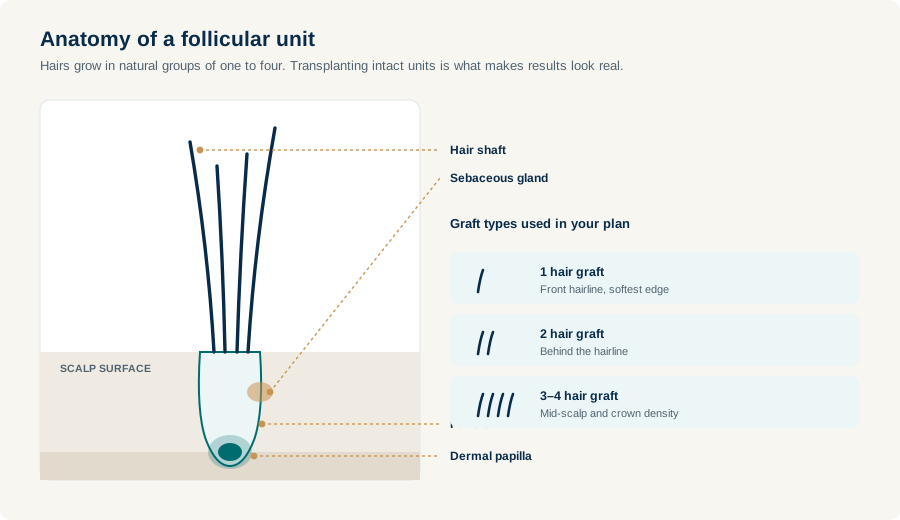
How male pattern loss works
Testosterone is converted into dihydrotestosterone by an enzyme called 5-alpha reductase. In men with a genetic predisposition, DHT binds to receptors on follicles in the frontal scalp and crown, progressively shortening their growth phase.
- Miniaturisation beginsEach growth cycle produces a slightly finer, shorter hair.
- The hair becomes vellusWhat was a terminal hair becomes fine and colourless, like body fuzz.
- The follicle stops producingEventually the cycle fails entirely and the follicle becomes dormant.
- The window closesOnce dormant for long enough, the follicle cannot be revived by any current treatment.
Other causes worth ruling out
| Cause | Pattern | Reversible? |
|---|---|---|
| Telogen effluvium | Diffuse shedding after illness, stress or surgery | Usually, within 6–9 months |
| Iron deficiency | Diffuse thinning | Yes, once corrected |
| Thyroid dysfunction | Diffuse thinning, often with other symptoms | Yes, once managed |
| Alopecia areata | Discrete round patches | Often, though unpredictable |
| Traction alopecia | Loss along tension lines | Yes if caught early |
| Scarring alopecias | Patchy loss with smooth, shiny skin | No, but progression can be halted |
Sudden, patchy or diffuse loss deserves proper investigation rather than an assumption of pattern baldness.
 Clinically reviewed by Dr. Ducu Botoaca
Aesthetic & Hair Transplant Surgeon and founder of The Men Clinics, Soho, London. This page is general information and is not a substitute for a personal medical assessment.
Clinically reviewed by Dr. Ducu Botoaca
Aesthetic & Hair Transplant Surgeon and founder of The Men Clinics, Soho, London. This page is general information and is not a substitute for a personal medical assessment.
Frequently asked questions
Is hair loss inherited from my mother's side?
That is a persistent myth. The genetics are polygenic, with contributions from both parents. The androgen receptor gene on the X chromosome comes from your mother, but many other genes are involved, which is why family patterns are unreliable predictors.
Does wearing hats cause hair loss?
No. Hats do not cause pattern baldness. Extremely tight headwear worn constantly could theoretically contribute to traction alopecia, but ordinary hat wearing has no effect.
Does stress cause baldness?
Stress can trigger telogen effluvium, a diffuse shedding that usually recovers within six to nine months. It does not cause male pattern baldness, though it can make existing thinning more obvious.
Can hair loss be reversed?
Miniaturising follicles can often be improved with medical treatment. Follicles that have been dormant for years cannot be revived by any current treatment, which is why early action matters.
At what age does hair loss usually start?
It varies widely. Around a quarter of affected men notice changes before thirty, and roughly half by fifty. Earlier onset tends to indicate a more advanced eventual pattern.
KEEP READING
More hair loss guides
Ready to talk to a specialist?
Book a free, no-obligation consultation at our Soho clinic. You will get an examination, an honest assessment and a written plan with no deposit requested on the day.
The information on this page is general guidance and is not medical advice. It does not replace a personal consultation with a qualified clinician. Individual results vary. The Men Clinics, Soho, London.